If you run an education platform, a surprising share of your AI bill goes to very small decisions made very many times. Is this uploaded document a scam? Does this exercise match this curriculum topic? Should this post be flagged for review? Each decision is narrow and well defined, and most platforms answer it the same way: send the content to a frontier model API with a prompt. That works, but two costs grow with your volume. The obvious one is the invoice. The quieter one is false positives: every legitimate document wrongly flagged is a real student or teacher whose upload gets blocked, and at millions of uploads a month even a few percent becomes a support queue.
We build these classifiers, and in our work with education platforms the same pattern keeps showing up: a small model fine-tuned on the platform’s own data matches the big general-purpose models on accuracy and beats them on cost and false alarms. Three examples below: two in production at scale and one from a recent evaluation.
What is distil labs?
distil labs is a platform that fine-tunes task-specific small language models automatically. Most people use it to swap the general-purpose LLM behind a product feature for a smaller, purpose-built one: same quality, around 80% lower cost, lower latency. We take the data a team already has, generate synthetic training data from it with a large teacher model, train a small model that matches frontier quality on that one task, and deploy it to an OpenAI-compatible endpoint, so switching is essentially repointing the client you already run.
Pattern 1: classification at hundreds of millions of requests
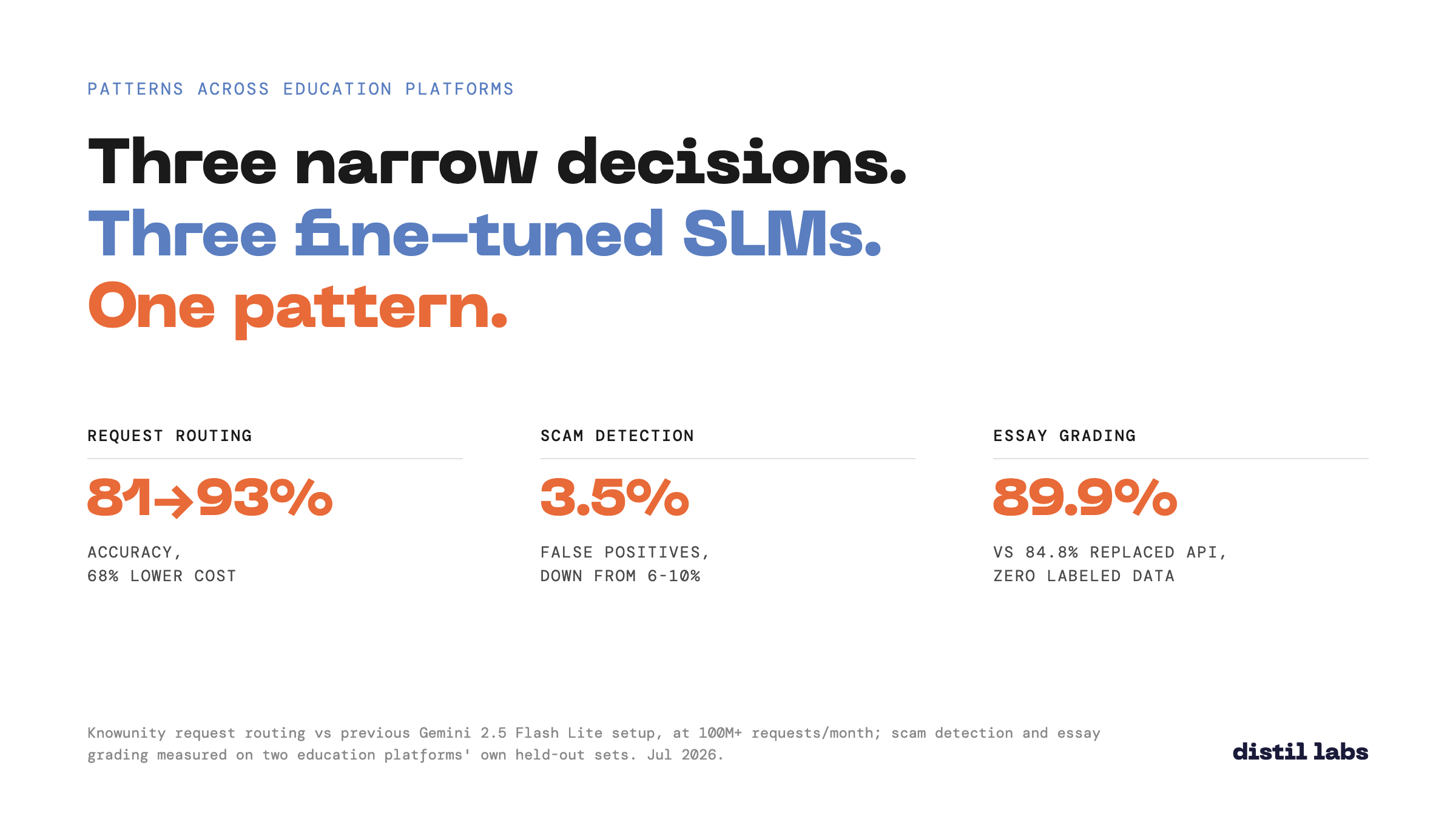
Knowunity, a learning platform for students, classifies every incoming student request to route it to the right workflow: which subject it belongs to and how complex it is decides what handles it. That classification runs on distil labs models at hundreds of millions of requests per month. Compared to their previous Gemini 2.5 Flash Lite setup, accuracy went from 81% to 93% while inference costs dropped 68%. The small model is not a compromise for the budget’s sake; it is more accurate on the task and cheaper at the same time.
Pattern 2: catching scams without flagging students
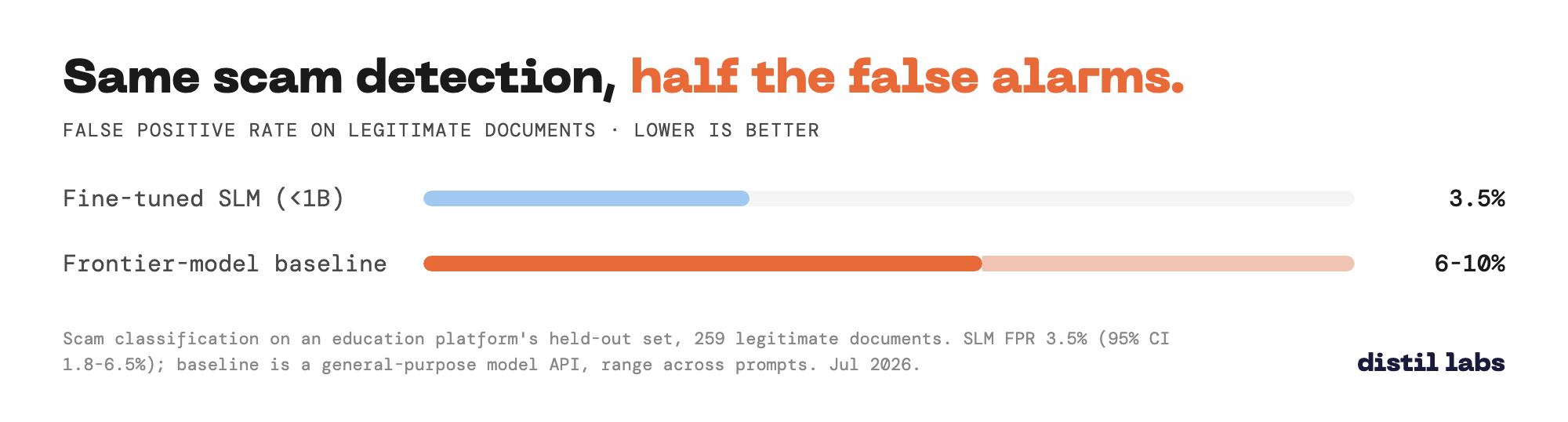
More recently we evaluated scam detection for a different education platform, one where users upload documents. Their production setup, a general-purpose model API with a tuned prompt, caught most scams but wrongly flagged roughly 6-10% of legitimate documents. On the platform’s own held-out evaluation set of 374 documents, a fine-tuned model with under a billion parameters caught scams at a rate matching the production model’s best (82% vs its 71-83% range), was more precise about what it flagged (91% vs 74-85%), and cut the false positive rate to 3.5%, roughly half the baseline. On a test set this size the precision and false-positive gains are the deltas that hold up statistically; the detection rates we read as parity, not a win. Same protection, half as many innocent uploads blocked, from a far smaller and cheaper model.
To be clear about the limit: about 1 in 5 scams still gets through, so this is a strong, cheap first filter rather than a wall, and every number here is task-specific until you evaluate on your own data.
Pattern 3: grading essays with no labeled data at all
The third example is a learning platform that grades student essays against official exam rubrics: the model reads the exam prompt, the rubric, and the essay, then produces scores and a written justification. This is a harder shape than classification, structured judgment rather than a yes/no, and the platform was running it on a large reasoning model API.
Here the training data cost nothing to create. The platform’s existing production logs, about 4,000 logged requests and responses, were the entire input; nobody labeled a single essay. We used those traces to fine-tune a 4B model. On the platform’s own held-out set it scored 89.9% against an LLM judge, ahead of the production model it replaced (84.8%). It now serves production traffic, at a fraction of the size and cost of the model it replaced.
If an LLM already runs inside your product, you are already generating the training data for its cheaper replacement.
Why this fits education platforms specifically
Education workloads combine three things that make this trade unusually good:
- Enormous request volumes, so per-request cost dominates the economics.
- Narrow, repetitive decisions, exactly what small models learn well.
- Student data, which favors models you can run in your own infrastructure rather than send to a third-party API.
Latency matters too; a small model answers in tens of milliseconds, which keeps classification out of the user’s way.
Try it on your task
If a high-volume classification decision lives inside your product, you do not need a labeled dataset or an ML team to find out what a fine-tuned small model would do with it. A short task description and a handful of examples are enough to evaluate on your own data: get in touch and we’ll set it up.
distil labs trains task-specific small language models that are cheaper and faster per request than general-purpose LLMs, with equal-or-better accuracy on bounded tasks. Docs · GitHub · Slack